Showing posts with label George W. Townsend. Show all posts

Tuesday, March 15, 2016

Chapter 3 - Our First Lessons


September 17-19 1862

CHAPTER III
OUR FIRST LESSONS
On the 17th of September our officers at attempted to procure arms, and begged for permission to march us on towards the field of action, as the rebels were then in­vading “My Maryland.”
Old Captain Tarbutton, to whom the application had been made, politely informed them that they should rest easy, since they and their men would see fighting enough before their term of service would expire.  A verification that was lit­erally fulfilled.
On the 18th of the same month, the wounded from the battle field of Antietam reached Harrisburg, and part of the com­pany was detailed to assist in unloading the cars, freighted with the mangled and maimed Union soldiers, none of whose wounds had as yet been dressed.
To hear the moans and groans of the poor fellows, was sufficient to convince the most stout-hearted of Company G’s boys, that to play soldier was a very dan­gerous game and to say the very least, we had chosen an avocation that would certainly call us to places where death and destruction stalked through the land in an open and defiant manner.
We have always surmised that the experience gained upon that occasion had a great deal to do with several members of our company getting discharged from service on account of physical disability.  ­We remember one of these chaps who car­ried a beg of sweet potatoes on his shoulder on the day he was discharged, when a few hours before, he had been almost too weak to carry his discharge from one ward to the other.
The first guard duty that the company performed with muskets and accouterments, was on the 19th of September, 1862, in the Capitol grounds, upon the occasion of firing a salute of one hundred guns, in honor of the victory obtained over the Rebel Army at Antietam.
It was upon this occasion that the writer halted A. G. Conic, the then great war Governor. Upon being informed as to who it was that stood at the mercy of our bayonet, we brought the old fuzee to a present, recognizing the salute, his Excel­lency passed on.
At this time we were kept very busy do­ing guard duty on the hill.  The Capitol grounds were dotted with tents which had been used by the Militia, who had flocked in by the thousands to defend the State from the invasion which was then being threatened by the Rebels.
Here the members of the company had ample opportunity of playing the part of Sunday soldier in its brightest light.  The grounds were nearly always filled with strangers who visited Harrisburg to catch a glimpse of army life.
Soldiers are apt scholars, and we believe that we can truthfully claim as much aptitude and shrewdness for the members of Company G as was possessed by any other company, or at least it did not take our boys long to learn that it was a good thing to be provided with a piece of raw bacon, the fattest we could get, with several hard-tack, and whenever there would be any persons about who by their actions gave us reason to believe that they were friends of the soldier, we would seat ourselves near them on the ground, take out our “prepared” grub and commence to eat it with the keenest appetite.  As a general thing the first vender of pies and cakes that happened to pass that way would receive an order for the balance of stock, and as a natural result the soldiers would get something better than bacon for that meal.
Part of the above arrangement is what perplexed Peter Laubenstine our cook.  He reported the case to our officers in about the following words;
“I can’t understand what ails the boys, when they go to town they can’t get their meat fat enough and when they are in camp, why I can’t get the meat lean enough, it just beats the ‘old boy.’”
The officers said that it was strange, but it was impossible for them to tell how this change in the diet was brought about.  And as to the company cook he remained in ignorance until long after we left Harrisburg.
Time passed rapidly, we had been in camp two weeks, and the company under B.T. Parks’ skillful hands, was making rapid progress in the school of the company, and we were pronounced by Capt. Tarbutton to be the most efficient troops in camp.
Up to the 30th of September, our officers had not been announced yet, we had been actually awaiting to hear who the favored ones were to be.  At last the appointments were made, and at roll-call on the morning of November 1st, B. T. Parks called the roll in the following order for the first time. (I have added the officers in order that the company roster may be complete.

Captain      Charles S. Davis
1st  Lieutenant             Nelson Byers
2nd Lieutenant           William H. Schroyer
        NON-COMMISSIONED OFFICERS
1st  Sergeant           B. T. Parks
2nd      “                   James E. Lloyd
3rd           “                  George W. Townsend
4th       “                  Henry W. Baker
5th       “                  Franklin M. Stuck

1st  Corporal           Isaac D. Whitmer
2nd       “                  John R. Reigel
3rd        “                 Francis W. Wallace
4th        “                 Frederick B. Ulrich
5th        “                 Henry Shrawder
6th        “                 Jeremiah Malick
7th        “                 Samuel H. Bower
8th        “                 George W. VonNeida
MUSICANS
           Lewis C. Schroyer
           Antes Ulrich
                  PRIVATES
App, Solomon                    Millhoff, John
App, Jeremiah                    Miller, Elias
Bingaman, Jno. F.   Moyer, Jeremiah
Churchill, Asa B.    Mull, John
Doebler, Henry J.   Miller, Reuben
Eby, Amantes                     Matter, John
Ehrhart, Daniel                   McFall, William
Fisher, Edward                   Napp, Isaac J.
Fausnacht, W. E.    Nerhood, Jacob
Griggs, George D.   Noll, Elias
Garman, Jacob                   Noaker, George
Gross, Daniel W.    Parks, Calvin E.
Henninger, Win.     Parks, Martin L.
Herbster, Win. H.   Reed, Isaac E.
Herbster, Thomas   Reed, John
Hassinger, Allen     Romig, Levi J.
Hafley, Uriah P.     Reigle, Jacob J.
Herbster, Daniel     Reed, Isaac B.
Haas, John P.                      Schroyer, M. S.
Hathaway, Jere.      Shreffler, Henry E.
Jarrett, Samuel                   Stuck, John K.
Krebbs, Jacob                     Smith, James W.
Keller, William S.   Spade, William
Kreamer, Henry      Swab, Jacob
Knarr, Franklin                   Seesholtz, Win. E.
Kreamer, Daniel W. Swartz, John A.
Knight, Fred H.      Sholly, Adam S.
Lahr, Peter             Shaffer, Michael S.
Lahr, Daniel D.      Shiffer, Wm. H. H.
Long, John C.                     Templin, Stephen
Lumbard, Joseph A. Ulsh, Joseph S.
Leider, Jacob                      Ulrich, James P.
Mark, John T.                     Ulrich, Lot
Millhof, Elias
Millhoff, Lewis

     The above is a correct roster of the original company, as well as the first non-commissioned officers appointed by the officers, but by the discharge of Sergeant Lloyd and the transfer of Corp. Shrawder to the 14th United States Regular, other changes soon followed.
John A. Swartz was the first member of the company to desert, which he did on the 25th of September.  No effort was ever made to compel him to return. 
The company mustered all told, rank and file 88 men.  An effort was made during our stay at Harrisburg to have it recruited up to the maximum number, 101 men, and the following recruits to the company were secured.
 Bastian, Joseph F.
 Hoffer, Peter H.
Marks, Cyrus
Shearer, Jacob
Waughen, Wm. Henry H.
All of the above, excepting Hoffer, deserted, which take with Swartz, Daniel Lahr who also deserted, and Lloyd , discharged with Shrawder transferred, the company reduced to 80 men.

The name of Rev. Hall, who had died from an attack of small-pox and who lied buried in the Even. Lutheran Cemetery in Selinsgrove never had his name on the company roll, as he was endeavoring to secure Chaplaincy.


Chapter 4 - Life At Harrisburg

September 1862


CHAPTER IV
CAMP LIFE AT HARRISBURG

Immediately after the filling of the various hospitals, by the wounded from the battle-field of Antiem, an order was issued to Capt. Tarbutton, for troops do the guard duty at the hospitals, and our company was selected.  Thus half of the command was sent down to the city every other day.  10 men including a Sergeant and Corporal were sent to the German Reformed Church Hospital, corner of Third and Chestnut Sts., as well as a similar detail to the Walnut St., Cotton Factory and River Hospital.  The boys had the run of the city, all that was necessary was to have a pass countersigned by any of Sergeants’ on duty, and it was surprising to see how many Sergeants the company had.  In the language of Col. Charles Kleckner, then acting Provost Marshal of the city, “every d—d man of them is a Sergeant, for my patrol now have in their possession the hand writing of at least 16 men, all purporting to be Sergeants  in Captain Charles Davis’ Company.
For upwards of two months the Company was on detached duty in the city, and the temptations to which the boys were  exposed were of such a character as to be a snare to the feet of many of the unsophisticated youths of the company, to say nothing of the older ones.
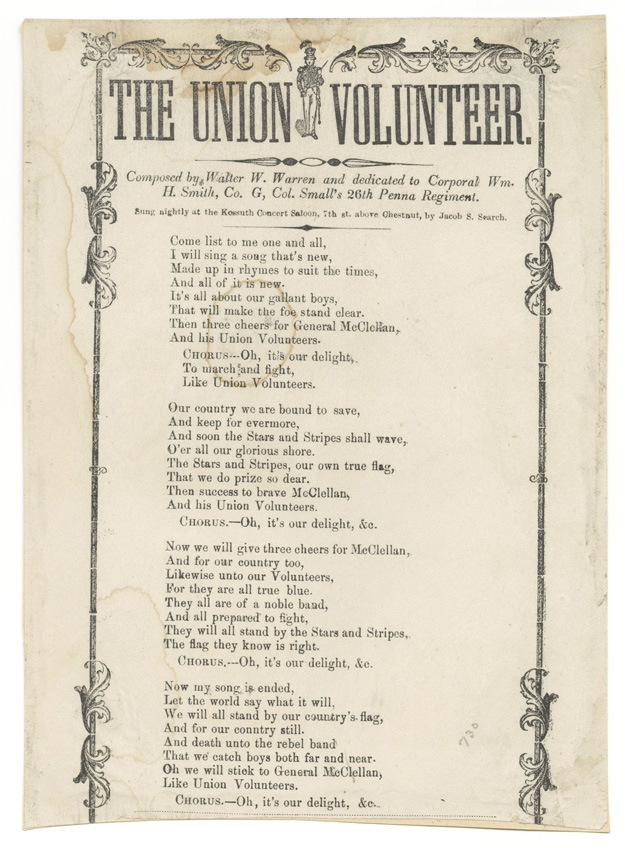
At the time when Company G, known as Captain Davis’ Snyder company, made its appearance on the scene, Bob Edward’s Concert Saloon was in its zenith, and the ballet, as well as the prevailing, eccentricities of the hour were nightly delineated by male and female STARS, to the great delight and astonishment of the gaping crowds of soldiers and among which might generally be noticed a fair sprinkling of Company “G’s” warriors.  Among the pleasant recollections connected with the concert saloon, then occupying the building opposite the Jail, near the State Capitol Hotel, are the now extinct “war songs,” not extinct be­cause they form a large portion of the reminiscences of the times which tried the hearts of the patriots of 1861--5, those charming songs, rendered by Julie Edwards and Lizzie Francis, among which we now call to mind: “We are going to fight for Uncle Sam,” “My Mary1and,” “Hurrah for General McClellan and the. Union Volunteers,” which seldom if ever, failed to draw forth an encore.  While speaking of the “Gaiety songs” we dare not forget “Ever of Thee,” and “Lauderbaugh,” names which carry us back to the time, when clothed in Uncle Sam’s suit of  blue, seated within its “classic” walls sipping lager, we just more than threw ourselves upon the wave of dissipation and lived upon the fleeting pleasures of the day, which were sure to bring us a heavy head in the morning, which would cause us to resolve “never to get drunk any more.”
Every organization has its character and we believe that Company G had its full share of them.  We cannot forget old Danny Kreamer, who wore a monstrous pair of green spectacles, and who upon a certain well-known occasion remarked that “he did not believe that he ever saw Sergeant Baker in a general manner.”
It was the same chap who after being treated to a breakfast on farina, brought to the Chestnut street hospital by Mrs. Small, said: “Well, I am a pretty old man, but I’ll be blamed if ever I eat mush and milk for breakfast.”  While we are speaking of this eccentric character, we may as well mention that Danny dealt in “charms,” consisting of printed slips, on which were printed words which were to protect the person who carried them from violence or dangers of any sort, and when he attempted to sell one to Serg’t George Townsend, for the moderate price of 25 cents, found himself caught by the throat in the iron grip of the Sergeant, who said: “Danny, this is too thin, your papers are no good,” and he choked the charm vend­er until his tongue hung out.
Of course the boys all remember who it was that guarded that “little Bucktail” Sergeant in the guard-house, and the accident which befell the valiant guard who became exhausted for want of sleep, and who rolled down the bank, greatly to the detriment of his clothing, and who was probably saved from freezing by the interference of Corporal Fred H. Knight who kindly assisted him into the “markee” and who just as freely helped him out in the morning, and why it was done.  We know that up to this time be has never been able to clean his skirts of the strange affair, while all those who slept in that markee that night, aver that there certainty was ‘something rotten in Dan(ny) mark.’
We trust that the members of the Company will accept the little pleasantries in the same spirit in which they are written, and not get angry, as we shall endeavor to give a correct account of the doings of the “boys,” and one and all will receive full credit for all that befell them, as far as we can remember the facts, or recall the funny incidents to mind.
The company had a number of accomplished foragers, who not only distinguished themselves in raids upon the enemy, but who made it a point to visit the markets early in the morning, and before the venders were up, take advantage of buying anything “cheap” that they could lay hands on, of course the boys had no money or at least very little, and the edibles displayed were too tempting to be resisted, and so general did this “foraging” become that nearly every member of the company had a large pocket made in the inside of the overcoat, and which was appropriately called the union “confiscation” pocket.
We remember upon a certain occasion that two of No. l’s mess, took sweet potatoes out from under a man who had his bed on them, and then finished up the job by walking off with some ten or fif­teen pounds of sausage, which served to gladden the hearts of the mess.
Nor can we forget the German “Kost­hause,” with its tempting motto: ”Kum do rouse stu dem Deitchen hause,” on the old weather beaten sign, kept by old “Mommy” and Nicholas, he who loved his “schnaps” so well, in the part of the city known as Verbecktown.  It was here that a number of the boys made their head-quarters and many an interesting little squib might be written of the events transpired here.
We could tell as how Daniel Ehrhart upon a certain occasion gave the old lady a two dollar bill in payment for a “bitters” and when she could not change it, he ordered her to give him credit for the bal­ance and how that balance was wiped out that afternoon, so that when Ehrhart in the evening came to get his “night cap,” and ordered it taken from his credit, just how surprised he looked when old Mommy said:
“Du lieber Gott im himmel mon, das geldt ist shunt long aus gedrunken.”
Ehrhart never found out who it was that squandered his credit., although he vowed vengeance on the guilty ones.

It was here that ten and twelve of the company would lodge in one room with three beds in it.  As a general thing eve­rything passed off smoothly as long as there were only three men for each bed, but when the fourth man came, then the circus would commence, and the struggle between the “ins” and the “outs” waxed warm.  We had the pleasure (?) of trying to sleep in the room one night, and we are free to confess that we scarcely received our “levy’s” worth of sleep.  It was the night that Lot Ulrich had placed a large carpet tack in one of Danny Herbster’s shoes, and then invited the old man to go along out to get a drink, knowing full well that if there was a man in the company that would not get up out of bed and put on his shoes for a drink of whiskey, that man was not old Danny.  To judge from the way the old man ripped out the Sny­der county “Dutch” we had no doubt but that the tack got in its work successfully.  Herbster accused C. E. Parks of setting up the job, and it was with great difficulty that the old man was prevented from doing Parks bodily harm.  The difficulty was at last amicably arranged by Parks setting up the “Greek fire,” for Danny and his boon companion, Levi J. Romig.

Chapter 7 - Harrisburg Soldier Life

CHAPTER VII
HARRISBURG SOLDIER LIFE
Among the many characters which served to fill up the membership of Company G, we will not forget Sergeant George Townsend.  George was a native of Maine, he had been a soldier in the 8th Massachusetts, had been in the riot in Baltimore on the 19th of April, and participated in the battle of Bull Run, had followed the sea for a number of years, was always ready for a fight or a frolic, and as may well be imagined when under the influence of “grog” which was pretty much all the time, he was rather a privileged character and was allowed to do pretty much as he pleased.
One morning George was Sergeant of the guard, with head-quarters at the Chestnut Street Hospital.  He gave the post in charge of Corp. Witmer, and started out on a lark, and by 10 o’clock was sailing under a pretty heavy head of “steam,” and while promenading one of the streets he fell in with Jack Williams, a notorious bad negro and a very giant in strength.  Just how the affair commenced will never be exactly known, but the result was a fight between the two.  The first intimation that we had of the affair was the announcement made by “Black Dick,” the half-witted colored lad, who for so many years run in front of the trains on the N. C. Railway at Harrisburg, and who but a few years ago met his death by being run over by a locomotive, came up to the Chestnut Street Hospital, where he gave the alarm saying, that the “sojers and de kullud men are fitin,” and that we had better hurry up or they would kill “de sojers.”  The guard hastened to the scene of the conflict, and as soon as they left, all the inmates of the hospital who were able to move, hastened to assist the soldiers.  When we arrived at the place where the fighting was going on, we found Serg’t Townsend under the darkey, bleeding from a stab in the mouth, and surrounded by a large number of negroes, the Serg’t was pretty well played out.  Ed. Fougat a member of Co. “A,” 127th P. V. I., threw a stone which bare1y missed the darkey’s head, and then seizing a club made for the darkey.  Williams jumped up and run into a negro shanty, into which he was followed and caught up on the loft.  A “Buck-tail” Sergeant had secured a hatchet and with it struck the darkey several strokes on the head sufficient to fell an ox, and which only had the effect of making him shake his woolly cranium.  The boys were determined to finish him, and finding that they had a tough customer on hand, U. P. Hafley attempted to wrench the musket out of the hands of Jacob Leider, who had been on guard at the Third St. entrance at the ­time the alarm was brought to the hospital, and who had taken his gun along.  Leider held on to the gun, and as it had a bayonet attached it was a fortunate thing for the negro as well all concerned that Hafley did not get the gun.  The darkey finally raised himself from the floor with two or three men clinging to him.  He was at last thrown down head foremost, and strange to say escaped without injury.  A number or women had gathered in the shanty, and their screams were frightful in the extreme.  At last the patrol arrived on the ground, and the darkey was arrested and taken to jail.
Court being in session, the following day the darkey was arraigned, indicted upon the charge of assault and battery with intent to kill.  He was tried, found guilty and sentenced to the Eastern Penitentiary for three years and six months.  We have always felt as though the sentence was rather an imposition upon justice.  Jos. C. McAlarney, Esq., formerly of this place defended Serg’t Townsend.
The Company made White Hall Saloon its Head-quarters and almost any hour of the day, one or the other of the boys were to be met in the institution.


Monday, March 14, 2016

Chapter 10 - The 147th P.V.I.


CHAPTER X
THE 147TH  P. V. I.
Shortly after the events narrated in the previous chapter, an event took place which sealed the destiny of our company.
On the 10th of November, Major John Craig of the 147th P.V.I., arrived at Harrisburg in search of new companies to recruit the Regiment to ten companies as required in order to entitle the regiment to its full compliment of field officers.
The regiment was then lying at Harper’s Ferry, under command of Colonel Arlo Pardee, Jr., late Major of the 28th P. V. I.  This was Col. John W. Geary’s old regiment and was organized with fifteen companies, and owing to an order from the War Department which called for the consolidation of all regiments with more than the usual number of companies to ten, the officers of the five surplus companies, viz. L,M,N,O and P decided upon organizing a new regiment to be denominated the 147th of the line.
It was with this object in view that Major Craig visited Harrisburg, he succeeded in getting Company “F” which was then lying in camp, having been recruited in Luzerne County, mostly in and around Hazelton, and commanded by Jacob Kreider, who was perhaps better known as old “Jack of Clubs.”
Major Craig made application for our company to join his regiment, and on the morning of the 12th of November, the officers of the company called the men in line and put the question of joining the old regiment, or whether they would wait until a new regiment was formed, to a vote of the company.
The boys were anxious to see service and with but one dissenting voice they voted to become Company G, 147th P.V.I.  Thus the fate of the company was sealed, and we sincerely believe, when we take into consideration the history of the organization, that an over ruling Providence had much to do with our selection.
At this time there was another company of men in camp, recruited from the whole of the United States including New Jersey, officered by Captain Alfred Schwartz and Lt. Daniel Bower, formerly editor of the Shamokin Herald, better known in after days as “Lt. Walk-Your-Beat.” This also joined the regiment and became Company H.
Our officers on the 14th of November then made application to be relieved from duty at the hospitals, which was promised should be done just as soon as any other troops could be furnished to take our place.
After this step was taken, the boys felt that they would soon be called to perform a soldier’s duty in good earnest, proceeded to make the best of the time allotted to them in Harrisburg.
It was whilst we were waiting to be relieved that Corp. Freddy Ulrich came to the Chestnut Street Hospital with a gentleman of Jewish descent, Freddy having informed him that our company was composed of “pack” carriers.  The Jew tho’t that Freddy meant that we had a Jew company, whereas Freddy only referred to the knapsacks which we were compelled to carry.  The stranger saw the joke and taking a number of the boys to Koenig’s Lager Beer Saloon, soon succeeded in getting them all full of beer and patriotism.  It was whilst in this condition that we visited the brewery and watched the modus operandi of manufacturing the liquid.
Whilst one the employees was up on a platform playing a stream of water through rubber hose from a hydrant into a large stand, containing the “mash,” Freddy Ulrich took advantage of the man when be had his back turned on the hydrant, and shut off the water.  When the man, who was a German, discovered the trick that had been played upon him, his tongue which appeared to be loose at both ends let fly a volley of German adjectives that almost staggered those who heard them.  Freddy nothing daunted, requested him to speak United States, which only added fuel to the flames.  The foreman came to the rescue, and the matter was settled by handing around a big copper dipper filled with fresh lager, which had the effect of restoring peace and harmony.
One of the characters who frequented Chestnut St., was “Fiery Facias,” a per­son whom some of the boys have occasion to remember to this day.
It was about this time, the 18th of November, that the body of John W. McBay, a member of  Captain George W. Ryan’s company, who died in Virginia, pass­ed through Harrisburg; a number of the boys went to the depot out of respect for him.  This event gave rise to the expression by  the “little one” [M. L. Parks,] of  “oh, how can a Selinsgrove man die with­out a bullet in his heart?”
After returning from the train, U. P. Hafley, D. W. Gross and the writer were arrested by the patrol, and taken to the guard-house. When we arrived there we met Levi H. Patterson, formerly a play­mate of ours, and who now was a member of company “A,” 127th, P. V. I., who interceded for us, and we were permitted to bunk with the guards.
On the following morning early we were taken before the Provost Marshal, Col. Chas. Kleckner, who heard us and gave us a paper previously prepared and sealed which he instructed us to give to the first patrol we should meet, and then dismissed us.  As soon as we were out of sight of the office, we opened the document and read as follows:
“Take these men to their quarters.”
Of course we did not think it necessary to have an “escort” since we were only privates, and made our way to hospital head-quarters without meeting a guard, and reached there just in time to go on boat.
Quite a number of the members of the company during our stay at Harrisburg had been arrested by the patrol, but were always released in the morning. One night however Henry Kreamer, Jeremiah Hathaway, Peter Lahr and several more were escorted to camp and placed upon the camp sanitary corps.  They had halted on their way out to camp and purchased penny musical instruments.  They came into camp, fully representing the “Little German Band.”
Upon one occasion, Serg’t Stuck and about 20 of the company were “gobbled” up at the depot.  As soon as the provost guard moved the column, which was in charge of a corporal, the boys decided that Stuck out-ranked the Corporal, and that he must take command, which he at once did.  For more than an hour we pa­raded the streets of Harrisburg.  When the Corporal in charge of the squad gave the command to “file left,” Stuck would countermand the order by a decided ‘right flank,’ and the boys would obey his com­mand greatly to the chagrin of the corporal.  Reaching the Provost Marshal’s office at last, Col. Kleckner informed us that since we belonged to the Snyder County Company, we might consider ourselves discharged, after which he ordered Serg’t Stuck to march us back to our quarters.
Nov. 20th, we received two months pay and two dollars bounty.  Thus equipped a number of the boys visited the Gaiety, and made a famous night of it, Serg’t Townsend and several of the boys got in­to a fight, and had they not been reinforc­ed by Lt. Schroyer and several others, who heard of the fight on the street, they would in all human probability have been ­cleaned out, as it was they came off conquerors.  The boys placed the “little one,” who as usual was conspicuous in jobs of this kind, upon their shoulders and march­ed off in triumph.

=============================================================


Chapter 11- Our Last Night In Harrisburg

CHAPTER XI
OUR LAST NIGHT IN HARRISBURG
We had now been in Harrisburg two months and six days, during which time we had made many firm friends, amongst whom we would mention the Smalls, Boy­ers, and Reighards, and it was with feel­ings akin to sorrow that we made arrange­ments for our final departure, but the many strange and exciting events which our imagination pictured, lured us on, and when the order came on the afternoon of the 20th of November, to pack up and march to the depot where transportation would be furnished to take us to the regi­ment, we had a number of regrets.  We will never forget our first experience at packing knapsacks for the march.  We were compelled to discard many things which we then thought we could hardly do without, and even then our knapsacks had the appearance of over filled peddler packs.
When the company filed out of the gate at Camp Curtin it had the appearance of a Regiment, and the squad that passed through the same arches nearly three years later, contrasted strangely with it.
The company was marched to the N. C. Rwy. Depot, to await the transportation.  Our officers had expected us to take the daily evening train, but owing to some misunderstanding this was not done.  Infor­mation was received about dark that we would not leave until after midnight, and the officers gave the men permission to take a farewell stroll through the city, to report promptly at the depot, no later than midnight.
A number of the boys started for the Gaiety, to take in the sights for the last time for many a long day, which had become so familiar to us, whilst others visite­d other points, just as their inclinations led them.
After the performance we repaired to White Hall Saloon, to partake of a farewell oyster stew, as well as to slake our thirst in several glasses of Michael’s lager.  Here we were met by Serg’t  F. H. Stuck who acted door keeper, demanding a fee from all who sought admittance, we paid and passed in.  When once within the saloon, a sight met our gaze, which we will not soon forget.  About two dozen of the boys were in the back room, whist fully that number were in the front or drinking department.
It was here that Sergeant Knight, assisted Jacob J. Riegel to eat cabbage, us­ing the handle of a small cracker mallet to help Jacob swallow it.  Serg’t I. D. Whitmer furnished the cabbage from the dish handful at a time, greatly to the detriment of the eater, whilst Serg’t Knight assisted in “rushing” it down, from which circumstance Riegel obtained the name of pusher, which he went by among his comrades to the day of his death.
Sergeant Stuck had collected a handful of stamps, pennies and promise to a script of the day.  Bill McFall gave Stuck’s hand a knock which caused his collection to fly in every direction, whereupon someone called out scramblings.  The rush that followed beggars description, and the way that furniture flew around was a caution.  After quiet was  restored and the money all recovered and counted, it was discovered that enough had been raised to pay for a glass of beer for any who wished to participate, and upon a count it was discovered that but one of the number present refused to take a glass, and this was not upon temperance bounds, but was mainly owing to the fact that a too liberal use of the fluid had knocked his pins out from under him, and he was at the time stretched out on a table in a side-room, covered over with a white spread and exhibited to all who cared to have a peep at the “Sleeping Beauty,” and a beauty he was.
We cannot recall the names of all who participated in that “cantico” but we have no hesitancy in asserting that all who were there and have occasion to visit Harrisburg will not fail to call at “White Hall” in commemoration of that farewell banquet.
The clock on the State House tolled the hour of midnight, and we found it necessary to say “good-bye” and hasten to the depot.  We found that the company had been removed to the Soldiers’ Rest and that a number of the most trusty men in the company had been placed on guard to prevent the men from leaving the building.
Three members of the company, D. W. Gross, U. P. Hafley and the writer were transferred to the 14th U. S. I., but owing to a Proclamation issued by the Government on the previous day, forbidding the transfer, the “Regulars” were returned to the company, this probably gave rise to the placing of guards at the Rest.  The boys however who knew the “ropes” had all the liberty they desired.

During the evening several knock-downs took place in the company, in one of which George B. Townsend knocked Danny Herbster topsy turvey, and which was settled by the interference of Lieut. Schroyer, who was always on hand whenever the rights of any of the company demanded it, whilst another took place between two of the company, both of whom are no more, besides a number of mouth battles, a species of warfare in which the members of Company G, were in, and for which the company was noted as long as it had an official existence. 

==========================================================


Chapter 12 - Off At Last


CHAPTER XII
OFF AT LAST
At length the officers were informed that the train was ready, and we took our line of march for the Depot, and took possession of the two cars provided for us.  As may be well imagined the boys made considerable noise, feeling very jubilant under the circumstances.  It so happened that a young officer on his way to return to his command, got into the cars with the company, and not relishing the noise and withal anxious to show his authority, intimated to our officers that he would like to have charge of such a company, that he would soon get them under his control, and that the way they were acting was a disgrace to the service.   Captain Davis expressed his entire willingness to transfer the company over to him until we arrived at Baltimore, or as far as he should go with us.  Captain Davis saying that he was only a YOUNG officer did not know much about discipline, and giving the company over to the Major, and after winking innocently (?) at several of the boys he passed out and took a seat in the front car.
 As soon as the Captain left the car, the most of the boys ignorant of the change in Commanders, commenced in good earnest and the confusion was much greater than before.  The Major sprang to his feet and walking to the center of the car, and in louder tones shouted “silence!”  The suddenness of the command brought the boys I who were singing the “Union Volunteer,” in their best style, to a sudden halt.  For a tine the gallant Major’s face was wreathed in smiles at his apparent victory, and like the Irishman it was well for him that he had his laugh first.
As soon as the boys took in the situation there was a perfect shower of questions hurled at him, the most conspicuous of which was “who in the hell are you?”— before he could reply Ed. Fisher had struck him square in the face with a loaf of bread, which be threw at him from his seat, this was the signal for the commencement of hostilities, and the bread, crackers, bologna, cheese, blind robins, &c., &c., flew as thick as hail, whilst the gallant Major was shielding his face from the storm of things which were being pitched at him, someone snatched his cap from his head, whilst Sergeant Townsend caught him by the seat of his trousers and the nape of his neck, Abel Seesholtz pull­ed the bell rope, and as the train slowed up, the Major was unceremoniously hustled out on the platform and pitched out on a bank, the conductor in the mean time had signaled the engineer to proceed and thus the gallant Major was left behind to make his way to the next station as best he could.
Captain Davis soon after came into the car and when told of his successor’s fate, a broad smile illuminated his face, and he went out with the remark:
“Well I declare boys, it is really too bad with you.”
We knew it was, but then it could not be helped.  The train run with its accustomed speed, and when the sky began to be streaked with gray, many of us caught our first glimpse of “My Maryland.” How eagerly we looked for the first indication of anything that looked like real soldering, and when the first soldier was discovered doing guard duty along the railroad near Baltimore, and shortly afterwards a small fort on the right side of the road, the boys rushed for the windows with the same eagerness that they had for Stuck’s pennies at the White Hall.

===================================================