Showing posts with label Captain Davis. Show all posts

Monday, March 14, 2016

Chapter 12 - Off At Last


CHAPTER XII
OFF AT LAST
At length the officers were informed that the train was ready, and we took our line of march for the Depot, and took possession of the two cars provided for us.  As may be well imagined the boys made considerable noise, feeling very jubilant under the circumstances.  It so happened that a young officer on his way to return to his command, got into the cars with the company, and not relishing the noise and withal anxious to show his authority, intimated to our officers that he would like to have charge of such a company, that he would soon get them under his control, and that the way they were acting was a disgrace to the service.   Captain Davis expressed his entire willingness to transfer the company over to him until we arrived at Baltimore, or as far as he should go with us.  Captain Davis saying that he was only a YOUNG officer did not know much about discipline, and giving the company over to the Major, and after winking innocently (?) at several of the boys he passed out and took a seat in the front car.
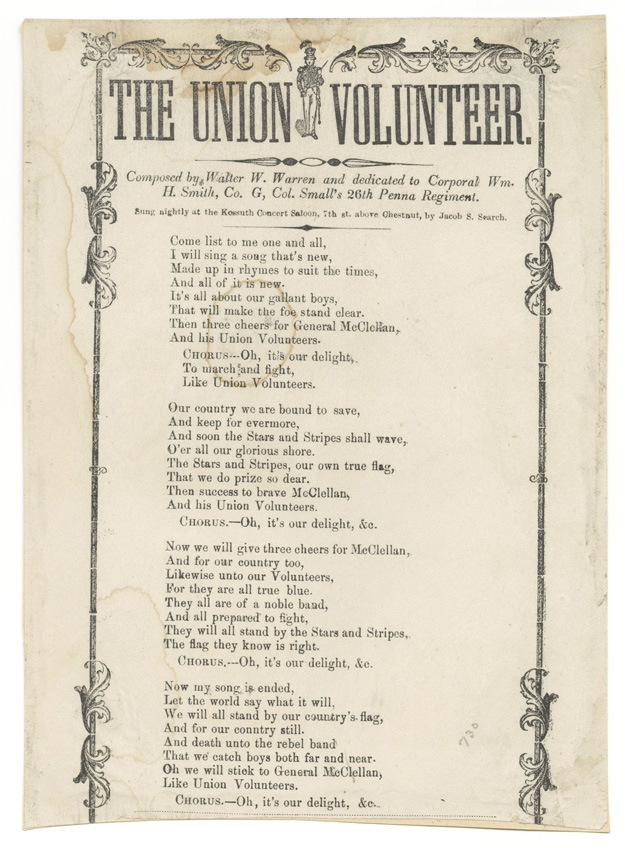
 As soon as the Captain left the car, the most of the boys ignorant of the change in Commanders, commenced in good earnest and the confusion was much greater than before.  The Major sprang to his feet and walking to the center of the car, and in louder tones shouted “silence!”  The suddenness of the command brought the boys I who were singing the “Union Volunteer,” in their best style, to a sudden halt.  For a tine the gallant Major’s face was wreathed in smiles at his apparent victory, and like the Irishman it was well for him that he had his laugh first.
As soon as the boys took in the situation there was a perfect shower of questions hurled at him, the most conspicuous of which was “who in the hell are you?”— before he could reply Ed. Fisher had struck him square in the face with a loaf of bread, which be threw at him from his seat, this was the signal for the commencement of hostilities, and the bread, crackers, bologna, cheese, blind robins, &c., &c., flew as thick as hail, whilst the gallant Major was shielding his face from the storm of things which were being pitched at him, someone snatched his cap from his head, whilst Sergeant Townsend caught him by the seat of his trousers and the nape of his neck, Abel Seesholtz pull­ed the bell rope, and as the train slowed up, the Major was unceremoniously hustled out on the platform and pitched out on a bank, the conductor in the mean time had signaled the engineer to proceed and thus the gallant Major was left behind to make his way to the next station as best he could.
Captain Davis soon after came into the car and when told of his successor’s fate, a broad smile illuminated his face, and he went out with the remark:
“Well I declare boys, it is really too bad with you.”
We knew it was, but then it could not be helped.  The train run with its accustomed speed, and when the sky began to be streaked with gray, many of us caught our first glimpse of “My Maryland.” How eagerly we looked for the first indication of anything that looked like real soldering, and when the first soldier was discovered doing guard duty along the railroad near Baltimore, and shortly afterwards a small fort on the right side of the road, the boys rushed for the windows with the same eagerness that they had for Stuck’s pennies at the White Hall.

===================================================


Wednesday, March 9, 2016

Chapter 20 - On The March

CHAPTER XX
ON THE MARCH
We soon had our supper prepared and about as hastily dispatched the same, after which we begin to make our preparations for the night.
Corporal Eby proposed that he would take his trick on duty, which would save him the necessity of remaining awake to post the relieves, and at the same time re­duce our duty to that extent. Giving Eby the preference on account of his stripes, he took post first, whilst the remainder of us wrapped our blankets around us and soon found repose and forgetfulness in profound slumber, which was not disturb­ed until we were aroused by one of the boys to take our station on duty.
To those who have paced the lonely beat, or stood silently watching for the approach of an unseen enemy, or perhaps crouched upon the earth with the organs of sight and hearing taxed to the utmost tension, to discover anything that might possibly be occasioned by the stealthy approach of the much dreaded bushwhacker, will be able to fully sympathize with us upon this occasion.  The various pick­et fires which in the earlier part of the night had blazed forth so brightly had almost disappeared when we took our trick, and only now and then as the dying embers were stirred up by some guard or half-frozen soldier, was there any fire vis­ible.  As is the experience of all soldiers, the two hours that we were on duty, were apparently much longer than the six we were off. At length however we heard the other pickets along the line being re­lieved, and after standing a little while longer we called McFall and again laid down to sleep, thankful that half of our trick had been faithfully performed.
Long before our time had come to go on post, we were awakened by old General Jack Frost, and when we got up we found that the old General had wakened up the rest of the boys, who had gathered around the fire and were endeavoring to coax some green twigs to burn, but which like the old woman’s chimney would do nothing but smoke.
After a number of ineffectual attempts to make the fire burn, we gave up in despair, and seated ourselves upon our ponchos, threw our blankets over us and tried to resign ourselves to our fate, but it was no use, the cold was too much for us.
At last a happy idea struck Eby, which was nothing more or less, than that we spread the four ponchos, or gum blankets, on the ground with one of the woolen ones and then use the other three blankets over us.  We did so, and were astonished to find how much warmer three blankets were than one.
Just as the east sky began to be streaked with the light gray tints of the morning, heralding the approach of the king of day, the division bugle announced that preparations for the day’s advance would now be in order.  Soon the Brigade bugles took up the strain and were soon responded to by the regimental drum corps.  The pickets began to pack up and prepare to join their respective commands.  It did not take us long to get ready to join the boys, but finding that we did not get relieved as soon as we expected we ate our breakfast, which like on the previous day consisted of crackers and speck.  We had some of the coffee left that had been given us on the previous day, and all that was needed was a proper vessel to boil it in.  While we were debating how to get one, an officer’s servant passed the post with a two quart coffee kettle dangling from his haversack.  Maxey McFall seized his gun, and aiming it at the darkey and commanded him to drop the kettle, this at first he refused to do.  “Click” went the hammer of the gun, as Maxey cocked it, and the darkey getting excited, handed over his kettle to us.
Soon the regiments began to move, but by some oversight we were not relieved until after 9 o’clock, when we were pushed rapidly ahead.  The road was filled with teams, artillery and troops, and we found it very difficult to make very much progress.
Whilst on our way to overtake the line, Gen. Geary and his staff came riding up.  The General halted us and upon learning where we belonged and how we had been left behind, ordered us to move forward briskly until we should join our regiment.  We had heard of the General’s hasty temper, as well as of his big boot, and were all somewhat nervous when he first talked to us, and we just more than made haste as long as he remained in sight.
We came up to the regiment at about 5 o’clock, and soon after our Division moved into a field and cooked dinner.   Here the Colonel found fault with the company for the first, and we believe only time, we were ordered to stack arms, and our company not having any arms before the day previous, we were naturally a little awkward, and since the greater part of the Division officers witnessed our blunder, and being anxious to have his regiment show up well, was naturally a  little nettled, and riding up the company on a gallop said: “D—m you Captain Davis, will your men never learn to stack arms?”
“Wait and see Colonel,” was the quick reply of our Captain.
The Colonel road to the rear of the regiment amidst the smiles of those who had heard the reply.
The boys soon had a roaring fire going and, Laubenstine coming up, the coffee kettles were hung over it, and in less time than it takes to tell it we were ordered to fall in for coffee.
We lay in the field for several hours, when the bugle again sounded the advance and we moved forward again being greatly refreshed by the rest and dinner.  On passing a farm house in the course of the afternoon, the boys discovered some chickens in a field and immediately started in hot pursuit.  The Colonel called the men back, one of our boys having almost succeeded in capturing one, was rather slow to give up the chase, and the result was, in the evening after the regiment had gone into camp, he was sent for to carry wood for the Colonel’s fire, as a punishment for violating the order prohibiting foraging, and how the Colonel knew the boys name will be easily understood when we inform the reader that the forager carried a knapsack that bore the following inscription:
“J. C. Long, Co., G, 147th, P. V. I.”
Considerable trouble was also occasioned by the fact that we did not know our guns as yet, which difficulty was increased by several parties, Lot Ulrich in particular, who had his name written upon the strap of no less than half a dozen guns, so that he would be able to claim, and also prove the claim by showing his name, which he had no trouble to do.  So well did this become known that when he claimed his own gun he had trouble to keep it.  It frequently happened that some one of the boys, bent on a little fun, would steal his gun and when Lot would claim the gun, the matter would be left to the company, which certainly would decide against him, and the fun would commence.  Lot would go from gun to gun and before he was through would claim a dozen, and at least one of someone else’s and cut or write his name upon the strap.
Those who have carried a musket or a knapsack during the late unpleasantness or any war, will bear us out that the assertion that growling soon becomes ­chronic, and that some one can be found at all times who upon the slightest provocation will furnish the “chin music” for the benefit of his comrades.  We at least have no hesitancy in stating that old Company G had a sufficient number of growlers to stock a brigade.  We had our marching growlers as well as our camp growlers and cowardly skulking growlers, in short we had them of all kinds.  Foremost upon the list of marching growlers came Jeremiah Moyer.  He always carried one of the heaviest knapsacks, never played out or skulked, but he had a terrible habit of fault finding as soon as we started on the march.  If the command moved slow Jerry would say, “I wish they would a march, if they a going to.”  Whilst on the other hand, if they marched fast, Jerry would say, “die verflucht kelver sie dadet une behauf dote marche eb sie uff geva.”  Thus after marching several hours Jerry would begin to find fault and universally end with a threat to soon fall out if the column did not halt to rest.  A threat which he never once put into execution, being always on hand for any emergency.

At about 4o’clock we came in sight of Leesburg, and went into camp about half a mile from town, having marched about 14 miles.

Saturday, February 27, 2016

Chapter 30 - In Camp


CHAPTER XXX
IN CAMP
Time passed along smoothly, our time being taken up between camp guard, picket duty and drill, company and  regimental, and the building of winter quarters.
It was here that Lieut. Wm. H. Schroyer met with a serious accident, which came near breaking his leg, he being in command of a detail to bring in wood to build officers quarters, and while assisting in tearing down an old house one of the pieces of timber fell on him and injured him­ severely, causing him to be unable for duty for the greater part of the winter.
Up to the present time, the 12th of January, the health of the company had been very good, but now a number of the boys, among them Lewis C. Schroyer, Ellis Noll, Corp. VonNeida and several others were removed to the regimental hospital, having been taken with Camp or Typhoid fever of the worst form.
 The boys in the hospital had considerable sport at the expense of poor El­lis Noll, who had the fever settle in his feet and they presented the appearance of a mammoth pair of boxing gloves and were as black as a silk hat.
Noll suffered excruciating pain in his pedal extremities, and would fre­quently give utterance to expressions, near to the following:
“These feet, them feet, those feet gracious what feet, oh, them feet.”
At one time it was feared that mor­tification had set in and that it would be necessary to amputate his feet in order to save his life, but his disease took a turn for the better, and he was, enabled to use “those” feet again.
Lewis C. Schroyer continued to grow worse, until on the morning of the 17th of January his spirit quit its frail ten­ement and entered into the presence of the great Judge, then and there to give a strict account of the deeds done here below, and to receive the reward or punishment, in accordance to the verdict of the Judge.
The death of Lewis C. Schroyer, it being the first, excepting Rev. Hall (who did not properly belong to our company as he was a candidate for the Chaplaincy of the regiment to which we might become attached) caused considerable feeling among his comrades.  Had he been stricken down in battle it would have not appeared so hard but to have fallen a victim to the malignant fever seemed to his com­panions a severe stroke.
Sergeant Stuck was detailed to ac­company the corpse home, and accord­ingly on the morning of the 18th of January, 1863, in company with a number of the boys, we had the last fond look at one who had been a companion of our earliest childhood, and whom we had ever esteemed as a true and tried friend.  The lid of the rough box was fastened down and placed in an ambulance was taken to the landing from whence in due time it arrived with its escort, and was interred with all the honors of war, in the 1st Lu­theran Cemetery, within a few paces where he had passed the greater part of his life, and where he is silently enjoying that sleep which shall know no awakening until Gabriel’s trump shall sound the alarm which shall cause the grave to give forth its dead.
On the afternoon of the 22nd a snow having fallen to the depth of four or five inches, the right of our regiment was attacked by the 28th P. V. I., which was attached to our Brigade and occupied a position to our right and front, and they were making it very lively for our regiment, using snow balls, having driven the right back as far as Company E., here they were struggling to get possession of the company flag, bearing the letter “P” which was their letter in the old regiment whilst in the 147th they were “E.”
Our company, about 80 strong were anxious to have a hand in the fracas but owing to the fact that the company persisted in claiming to belong to the 28th we held aloof and it was not until Lieutenant Tourison called upon Captain Davis to bring G Company to the relief of Company “E.”  This was all that the company wanted, the Captain sprang forward, and with a shout we threw ourselves into the breach and the flag was saved.  In vain the boys of the gallant old 28th attempted to drive us back.  Never, we believe, did a mimic fight partake more of the nature of a genuine engagement than did the snow-ball battle at Dumfries.  And as James Kilmartin furled up the company flag, which had caused the battle, he proposed three cheers for Company “G,’ which were given with a will.
After the cheers had subsided, Serg’t. Baker proposed three cheers for Company E and the 147th P. V. I.
The cheers were given with a will and from this time forward much of the ill-will which existed between the old and the new companies was forgotten and the best of feeling soon prevailed in the command.
About this time a number of the boys who were in the hospitals at Baltimore, came up to the company, from among them we remember Joseph S. Ulsh, who made his appearance decked out with a paper collar and necktie at the sight of which the boys greeted him with hearty cheers.  Joe informed the boys that the train in which they came up to the regiment had met with an accident whereby his baggage was destroyed, or he would have been able to supply the company with collars, as it was the only thing which he had left was the collar he wore and a pint bottle of “speerits” which Serg’t. Townsend drank as he-gulped about the half of it down, greatly to the disappointment of about half-dozen of the DRYEST of the men.  He pronounced it worth more down a parched throat than all the paper collars in the great United States, an opinion which a number of those present emphatically endorsed.
On the morning of the 25th of January the hearts of the boys were buoyed with the announcement that those who desired it could now have packages sent from home.
The boys hastened to their tents and soon were busy sending the glad tidings to friends at home, informing them of the news and requesting the forwarding of home luxuries.
We have before us a letter which was saved by the person to whom it was addressed, which we here publish, just as it was written, showing how the tastes of the writer run:

Dumfries, Va., Jan. 26, 1863

Captain Davis having told us that we can now have parcels sent us from home, if you can, I ask that you would send me a small request.  Boil 2 doz. eggs, hard; a can of apple butter; a cake of chocolate; 1 pint of brown sugar; tell the boys to crack and pit me about a pint of walnut g??????; a few sweet cakes; a little bag of flour to make gravy to my beef; send me the directions how to make sour dip; send ground pepper; get me a quart tin like Schroyer’s to boil my coffee in; make me three little bags to carry my salt, coffee and sugar in, make them large enough to hold a little more than a lb. with a string to draw them shut; send me a piece of ham; bake some fat cakes, a loaf or two of bread, several apple mince pies, right strong; put in several fish hooks and a line; if you can think of anything else that I am in need of send it along.  Send the box as soon as you can.  Send me the recipe in the next letter you write after you send me the box.
S.—Send a roast chicken, a piece of dried beef and some pickled cabbage.
No more at this time.
      From
                              Yours affectionately,

The above letter we consider about an average one of those written home with a view of hurrying along the good things, and in all cases, when it was possible, the wishes of the writers were pleasingly gratified.
The time passed away slowly enough whilst we were expecting the good things from home, and anxiously did we await the arrival of the first information that the boxes had been shipped, and that they were on their way, intended to cheer the hearts as well as fill the stomachs of the lucky receivers of the boxes containing the innumerable good things, prepared by the fond and willing hands of the near and dear ones at home.
John P. Haas was the fortunate individual who received the first box, and never we will forget his “damt ??? it” when upon opening the box found the greater part of its contents was spoiled.